
Table of Contents
Introduction
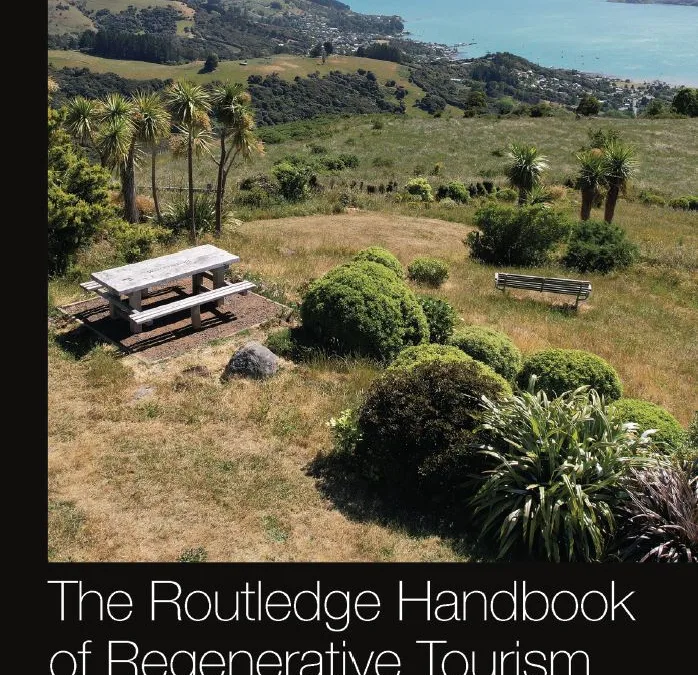
The Routledge Handbook of Regenerative Tourism, Edited By Francesc Fusté-Forné, Asif Hussain.
This timely and innovative handbook provides a comprehensive overview of the current critical debates, trends, and the transformative potential of regenerative tourism, and also looks towards a more responsible, inclusive, and sustainable future for tourism.
Comprising specifically commissioned, original contributions from recognised authors and experts in the field, the book provides a logically structured and systematic guide to the current state of knowledge in this area. It is interdisciplinary in coverage and international in scope through its authorship and content. The volume commences with an assessment of the principles and theoretical foundation of regenerative tourism, which provides a context to explore the policy, planning, development, destination management and marketing, local impacts, manifestations, and future of regenerative tourism.
This is essential reading for students, researchers, academics, practitioners, policymakers, government officials, and industry professionals interested in the possibilities of responsible and sustainable, and regenerative forms of tourism.
Critical Reviews

Table of Contents
Introduction
Francesc Fusté-Forné and Asif Hussain
Part 1. The principles and theoretical foundation of regenerative tourism
1. Indigenous values and regenerative tourism
Pauline J. Sheldon
2. Understanding regenerative tourism as a driver for transformational change in the 21st century
Pauline Marie
3. A framework for monitoring regenerative tourism through evidence-informed planning
Emmet McLoughlin
4. Understanding the anatomy of a regenerative business
Shirley Sheehan, Dimitrios Buhalis, Adele Ladkin and Isaac Ngugi
5. Positioning regenerative tourism within tourism qualitative research: A methodological inquiry
Paolo Mura
6. Using an ethical management framework for regenerative tourism: A case study of resident and visitor perceptions in Húnaþing vestra, Iceland
Jessica Aquino, Sarah Walter and Cécile Chauvat
7. Indicators of regenerative tourism: Measuring impact and defining regenerative tourism for socio-ecological systems
Asif Hussain
Part 2. Planning, development, management and marketing of regenerative tourism
8. Regenerative hospitality
Alessandro Inversini, Salma N. Talhouk and Alain Daou
9. Regenerative gastronomy in the tourism context: An overview
Alicia Orea-Giner and Sara Alonso-Muñoz
10. Human resources and regenerative tourism
Ester Noguer-Juncà, Montserrat Crespi-Vallbona and Nuria Louzao-Belmonte
11. Resilience in regenerative tourism: The Argentinian case
Maximiliano E. Korstanje
12. Tour guides and barriers to regenerative tourism: Unlocking the regenerative potential of nature destinations in Arctic Norway
Frida Marie Omma
13. Examining attitude and intention toward demarketing: The case of Mt Fuji
Caroline S.L. Tan
Part 3. The impacts of regenerative tourism
14. Regenerative tourism from an economic perspective
Alejandro Alcalá-Ordóñez, Juan Gabriel Brida, Pablo Juan Cárdenas-García and Victoria Mogni-Graña
15. Cultural impacts of regenerative tourism: Intrinsic connections between place and culture
Bronwyn Hutchison and Jenny Cave
16. Environmental impacts of regenerative tourism
Alexandra Coghlan
17. Challenges in transitioning to regenerative tourism: Territorial and economic scales of agency in rural Spain
Olga I. Mancha-Cáceres and Susana Ramírez-García
18. Beyond the beehives: Local development through Api-tourism
Mario Izquierdo Gascón
19. Enhancing Community Wellbeing via Regenerative Tourism? Aspirations and Approaches from Aotearoa New Zealand
Susan Houge Mackenzie
Part 4. Local stories from around the world
20. Regenerative food tourism at Grootbos: A South African case study
Hennie Fisher and Gerrie du Rand
21. Gastronomy as a driver for regenerative tourism? Risks and possibilities for a change of course in the chinampera zone (Xochimilco, Mexico City)
F. Xavier Medina, José A. Vázquez-Medina and Marco Covarrubias
22. Citizen science pilot project in Snaefellsnes, Iceland: The process of planning and implementation for future work in regenerative tourism
Jessica Aquino and Magdalena Falter
23. Transformative storytelling practices in regenerative tourism: A case study from a tourism operator
Marie Haley
24. Regenerative tourism ‘in the making’: Challenges of product innovation within existing structures
Kristof Tomej and Carina Ren
25. Exploring potentials for coral reef restoration in Pacific Small Island Developing States (PSIDS) as regenerative tourism
Phoebe Everingham, Po-Hsin Lai and Sascha Fuller
26. Okinawan cheese: The harmonization of cultures, land and regenerative tourism
Francesc Fusté-Forné
Part 5. Manifestations of regenerative tourism
27. Regenerative tourism seeds in urban regeneration: Evidence from Milan, Italy
Alberto Amore and Valeria Pecorelli
28. Reimagining nature-based tourism: A critical reflection on inspiring regeneration and ecological restoration
Ante Mandić
29. Regeneration in wellness tourism
Bendegul Okumus
30. Regenerative rural tourism: The concept and its application
Elisabeth Kastenholz, Bernard Lane and Arno Todt
31. Local food culture for regenerative futures in Nordic Arctic: Understanding of local food experiences
Magdalena Falter, Jessica Aquino, Francesc Fusté-Forné and Ólöf Ýrr Atladóttir
32. Creative tourism as a humanistic approach to regenerative tourism
Fiona Eva Bakas
Part 6. The future of regenerative tourism
33. Considerations of the regenerative tourism movement’s “claim” to indigenous knowledges
Freya Higgins-Desbiolles
34. The challenges facing the regenerative tourism movement
Jonathon Day and Katherine Pivaral
35. A regenerative approach for tourism SMEs: Five constructs for a regenerative tourism journey
Aisling Ward, Mary Rose Stafford, Fiona Scott-Hayward and Sophie Price
36. Digital technology and regenerative tourism
Alessandro Inversini and Dimitrios Buhalis
37. The regenerative traveler mindset
Irena Ateljevic and Mia Peric
38. For a future (re)generation: Modelling effective tourism communication for social–ecological development of local communities and destinations
Elena Mattei and Stefania M. Maci
Conclusion
Francesc Fusté-Forné and Asif Hussain
Critical Reviews
“This insightful book on regenerative tourism offers a comprehensive exploration of the field, blending theoretical reflections with methodological considerations and practical applications. Enriched by diverse empirical case studies from around the world, it provides an engaging discussion about the role of tourism to actively restore and enhance ecosystems and communities. Both academics, practitioners, and policymakers seeking transformative approaches to tourism will find this book interesting and inspiring.”
Giovanna Bertella, Professor, UiT-The Arctic University of Norway.
“The Routledge Handbook of Regenerative Tourism embraces the transformative telos at the heart of regenerative thinking and manifests it within the pages of the volume to nourish the reader with a cornucopia of perspectives on how, where, and why regenerative principles and practices are making change that matters in tourism places.”
Patrick Brouder, Associate Professor, Thompson Rivers University.
“Regenerative tourism has become increasingly significant as a subject of study in the search for acceptable and realistic alternatives to contemporary large-scale tourism, and this volume is by far the most comprehensive review and analysis of the topic by an impressive range of researchers in the field. Its six sections cover principles, operationalisation, impacts as well as case studies and examples both present and future. It could remain the classic text on the subject for some years.”
Richard Butler, Emeritus Professor, Strathclyde Business School, University of Strathclyde.
“This book addresses the pressing need for comprehensive investigations into the concept of regenerative tourism, a term frequently discussed but seldom fully understood. It makes a significant contribution by offering theoretical frameworks alongside illustrative and motivational case studies. The book challenges existing perceptions, highlights the limitations of past efforts, and encourages further research in this field.”
Anne-Mette Hjalager, Professor, University of Southern Denmark.
“The Routledge Handbook of Regenerative Tourism is a most welcome addition to literature on this topic which is emerging in various contexts across the world. This book takes the reader through a range of key perspectives from theoretical considerations, planning and implementation, dimensions and impacts to real-world examples. The various contributions, in total, or as separate chapters provide a rich resource for policy makers, students and practitioners alike.”
David G. Simmons, Emeritus Professor, Companion of the New Zealand Order of Merit (CNZM), Fellow of the International Academy for the Study of Tourism.