
Table of Contents
Akaroa Civic Trust Deputation. Presented on behalf of the Trust Chair, Marie Haley
Agenda Item: Coastal Hazard Adaptation Planning: Where to Next?
Policy and Planning Committee, Christchurch City Council
8 April 2026
Agenda can be found here.
The Akaroa Civic Trust deputation, presented on behalf of Chair Marie Haley, addressed the Policy and Planning Committee regarding the next steps for Coastal Hazard Adaptation Planning. The deputation urged the Council to prioritise the remainder of Banks Peninsula for climate adaptation planning, noting that the peninsula, and Akaroa in particular, is already experiencing significant and recurring impacts associated with climate change and sea level rise.
The presentation emphasised that Banks Peninsula communities are geographically isolated, highly exposed, and dependent on a limited transport network. The rural road network across the peninsula is particularly vulnerable to slips, flooding, storm surge, and erosion. When these routes are compromised, communities can be cut off from Christchurch for extended periods, creating safety risks and limiting access to essential services.
Recent severe weather events were highlighted as clear evidence of this vulnerability. During these events, Akaroa and surrounding bays were effectively isolated from Christchurch for prolonged periods due to flooding, road closures, and infrastructure damage. Communication networks were also disrupted, leaving some communities without reliable means to contact emergency services or receive critical updates.
The deputation noted that Akaroa experienced extended outages affecting numerous communication services, internet connectivity, and mobile phone coverage. These disruptions had immediate and practical consequences. Businesses were unable to trade, residents/tourist could not access funds, communication with emergency services became difficult, and coordination of community support was significantly constrained. In isolated communities such as those on Banks Peninsula, loss of connectivity compounds the risks associated with road closures and extreme weather.
The presentation stressed that these impacts are not hypothetical future risks. They are already occurring, and their frequency and severity are expected to increase. For this reason, the Trust emphasised the importance of proactive planning now, rather than delaying adaptation work. Prioritising Banks Peninsula within the Coastal Hazard Adaptation Planning programme would allow communities to better prepare for sea level rise, increased storm intensity, coastal erosion, and infrastructure vulnerability.
The deputation also highlighted that Banks Peninsula serves not only local residents but also visitors, rural industries, and emergency response networks. Ensuring resilience in transport routes, communication systems, and essential services is therefore critical for safety, economic continuity, and community wellbeing.
Why this matters
This issue matters because Banks Peninsula communities face compounding risks from isolation, limited infrastructure, and increasing climate impacts. When roads are cut and communication networks fail, communities are not just inconvenienced, they are vulnerable. Access to healthcare, emergency response, fuel, food supplies, and financial services can all be disrupted at the same time.
Delaying adaptation planning increases exposure to future events. Without clear planning, investment in infrastructure, evacuation routes, communication resilience, and coastal protection may not occur in time. Early prioritisation allows communities, council, and agencies to work together to identify risks, consider options, and plan for managed, staged responses rather than reactive decisions during emergencies.
For Akaroa and the bays, adaptation planning is not simply about long-term sea level rise. It is about resilience of roads, communications, lifelines, tourism economy, rural livelihoods, and the safety of residents and visitors. Planning now helps reduce future costs, supports informed decision-making, and strengthens community preparedness.
Decision and next steps
The Committee considered options for the next stage of Coastal Hazard Adaptation Planning,
Details on options are as below.
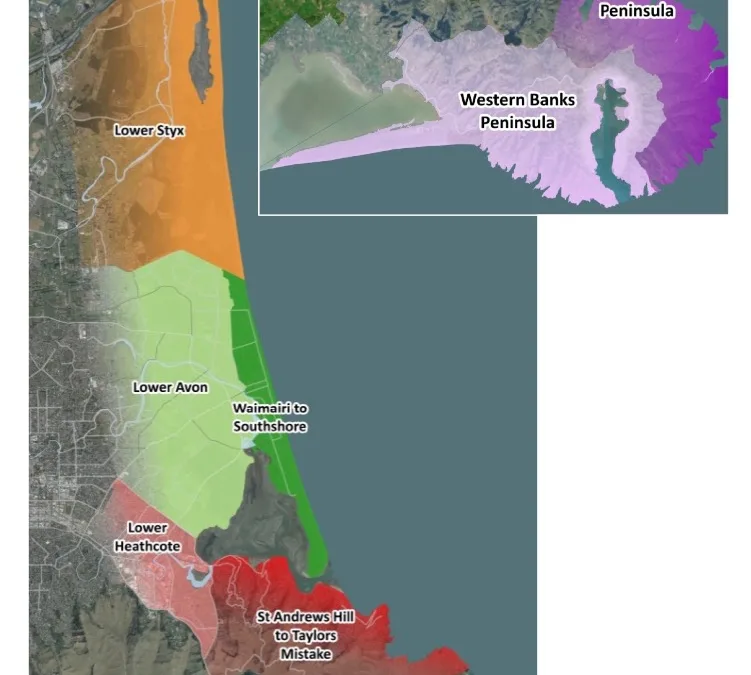
4.17 Option 1: Lower Ōpāwaho Heathcote River and St Andrews Hill to Taylors Mistake first (recommended).
4.18 As set out in the diagram below, option one initiates planning in the Lower Ōpāwaho
Heathcote River and St Andrews Hill to Taylors Mistake Adaptation Areas, followed by the
remaining areas of Te Pātaka o Rākaihautū Banks Peninsula alongside the lower
Pūharakekenui Styx River, and then the Lower Ōtākaro Avon River and Waimairi to
Southshore areas.
4.19 Option 2: The remaining area of Te Pātaka o Rākaihautū Banks Peninsula first.
4.20 As set out in the diagram below, option two initiates planning in the remaining areas of Te
Pātaka o Rākaihautū Banks Peninsula, then moves to the Lower Ōpāwaho Heathcote River
and St Andrews Hill to Taylors Mistake areas, the Lower Ōtākaro Avon River and Waimairi to
Southshore areas, and then the Pūharakekenui Styx River area.
Item No.: 7 Page 194.21 The option of starting in Lower Ōtākaro Avon River and Waimairi Beach to Southshore was
ruled out. While the communities in Lower Ōtākaro Avon River and Waimairi Beach to
Southshore are have the highest level of risk, communities have not signalled their readiness
for adaptation planning processes.
Voting and Final Decision
Following discussion, all councillors voted to adopt Option 1, this included the Banks Peninsula councillor, Tyrone Fields. The decision was opposed by CL Aaron Keown.
Deputation Link
For the full deputation, councillor questions, discussion, and final decision, watch the meeting recording at the link below.